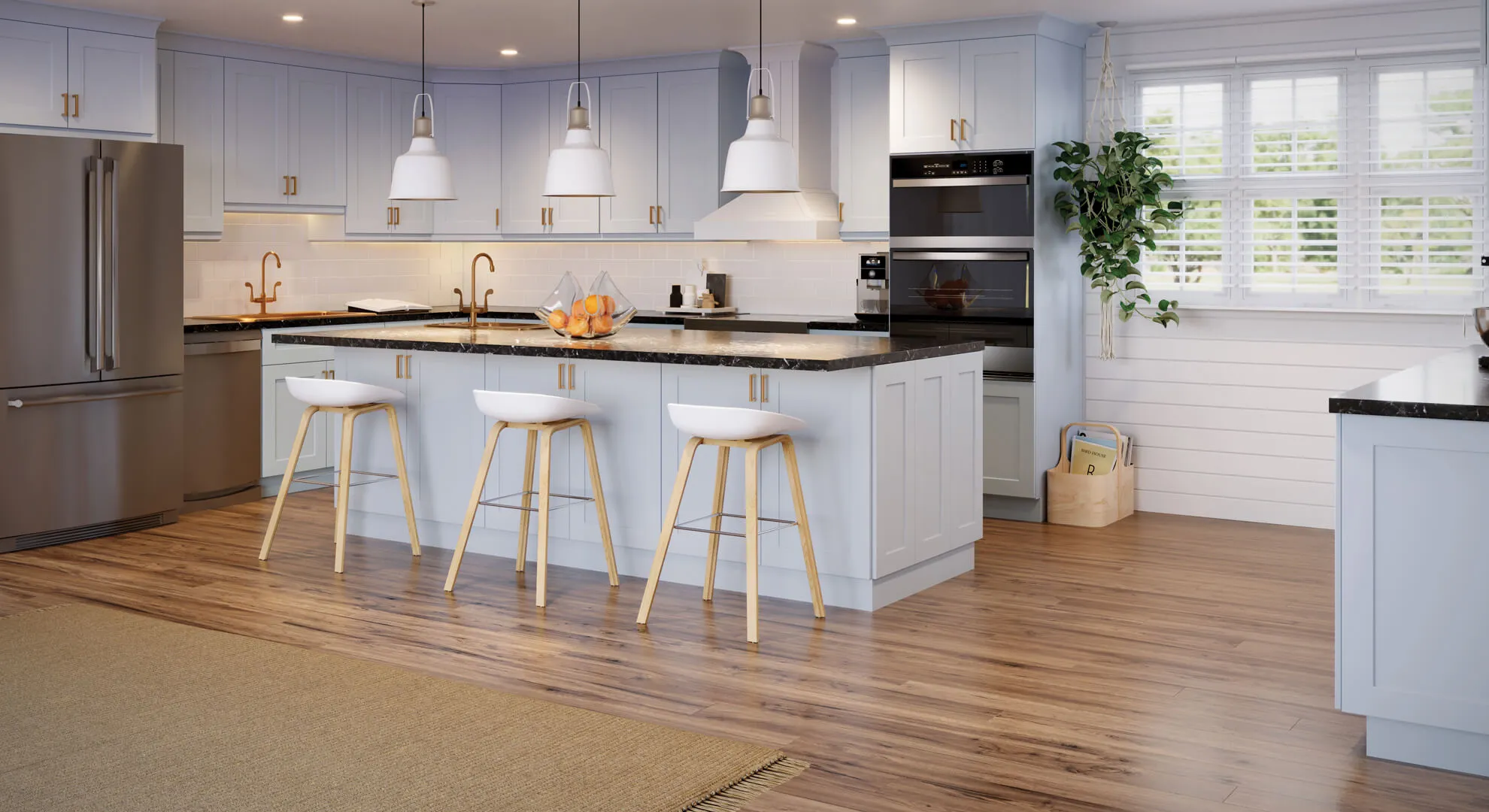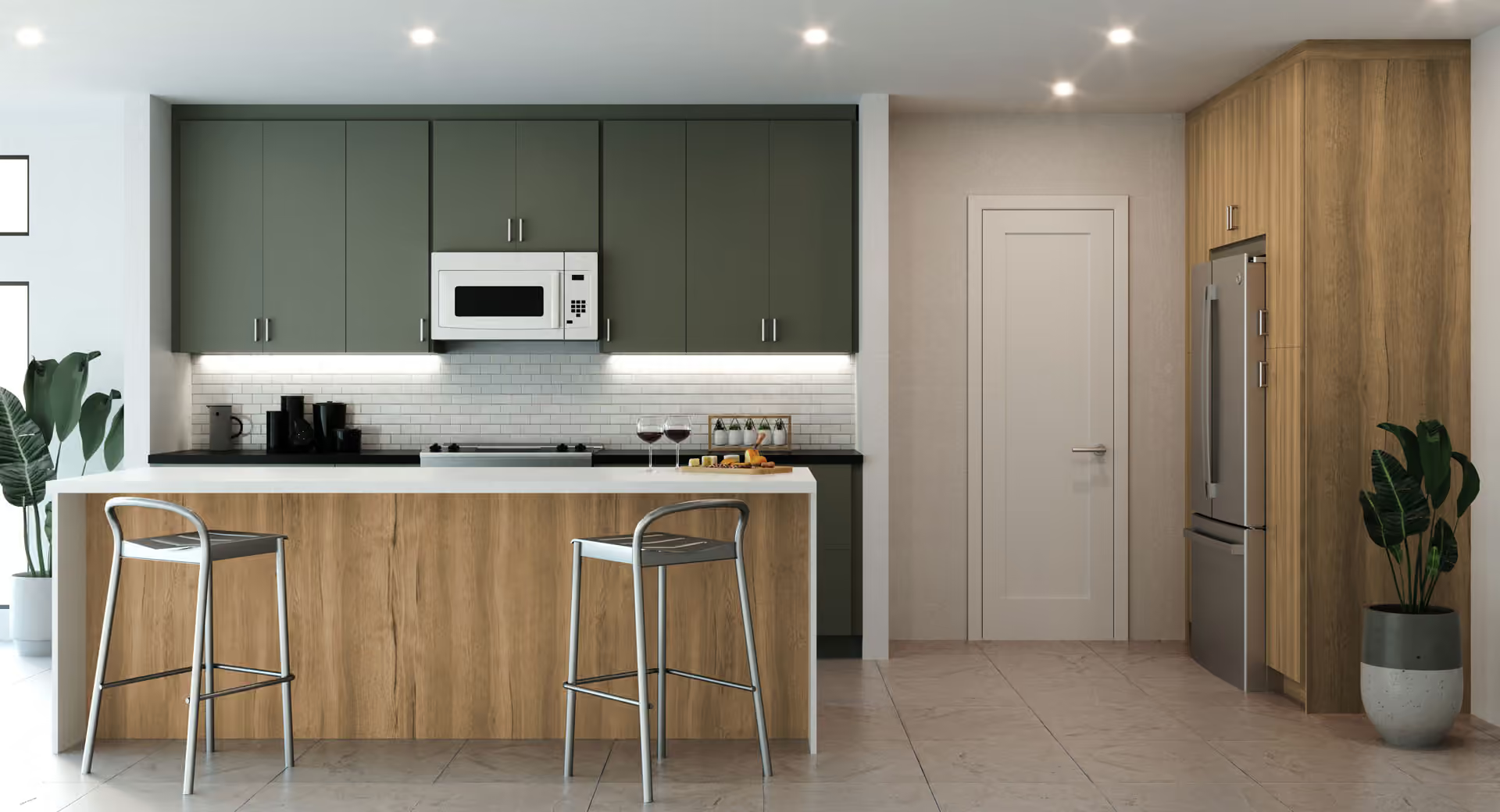
| Full overlay | Partial overlay | Inset | |
|---|---|---|---|
| Door position | Covers nearly the whole front | Covers part of the frame | Sits inside the frame opening |
| Gap between doors | Thin | Wider, frame shows | Thin, set by the fit |
| Face frame behind it | Not always | Yes | Yes |
| Look | Flat, modern | Traditional | Furniture-like, premium |
Source: KCMA and Kitchen Cabinet Kings. Innovation Cabinetry's Urban line is full overlay and full access.
What does full overlay mean?
Full overlay means the doors and drawer fronts cover almost the entire front of the cabinet. Only a thin gap shows between them. You see a flat wall of fronts, with little or no cabinet frame between pieces.
Kitchen Cabinet Kings gives a clear definition. Overlay refers to the amount of the face frame that the doors and drawers cover. If the doors hide nearly all of it, that is full overlay. If they cover only part, that is partial overlay. If the doors sit inside the frame opening, that is inset.
The word “overlay” always describes the door, not the box. That is why you can find full overlay doors on two different types of box. Face frame cabinets can have full overlay. Frameless cabinets always do.
Here is how the three door positions look in real use:
- Full overlay: a flat, continuous front. Common in modern and transitional rooms. See the full overlay glossary entry.
- Partial overlay: a visible band of frame around each door. A traditional look. See partial overlay.
- Inset: doors set flush inside the frame, with a fine gap all around. A furniture look. See inset.
What does full access mean?
Full access means the cabinet has no face frame, so nothing narrows the opening. You reach the whole interior through the door or drawer. Full access is another name for frameless, or European-style, construction.
Kitchen Cabinet Kings explains the benefit: full overlay doors allow full access to the cabinet’s interior, which makes it easier to reach items in the back and adjust shelves. The idea is simple. With no frame lip, the opening is as wide as the box.
The full access term also shows up in product names. Innovation Cabinetry’s Urban page lives at a “full access cabinetry” address, and the Urban page describes the line as a European-style cabinet. Full overlay frameless cabinets allow for wider drawer and door openings.
Are full overlay and full access the same thing?
They go together, but they are not identical. Full overlay is about the door. Full access is about the box. A frameless cabinet is both. A face frame cabinet can be full overlay, but it is not full access, because the frame still narrows the opening.
For a longer comparison of the two constructions, read the guide on frameless vs face frame cabinets.
How much wider can drawers and shelves be?
Wider by a meaningful margin. KCMA says that in framed cabinets the horizontal frame reduces the interior height of drawers, so tall items may not fit with the drawer closed. It also says framed cabinets often include a center stile that can block access to wide shelves.
KCMA gives practical size limits for the center stile:
| Cabinet type | Typical width before a center divider |
|---|---|
| Framed | Up to about 24 inches |
| Frameless | Up to about 36 inches for wide drawers and roll-out pantries |
Source: KCMA.
This matters for pots, pans and deep drawers. A 36 inch base cabinet in a frameless line can hold one wide drawer with no divider. A framed cabinet of the same width often needs a stile in the middle, which splits the opening.
Innovation Cabinetry says its full access frameless cabinets provide 15% more storage than framed cabinets. KCMA’s figure is about 20%. Both are general claims, and your layout decides the real gain. Do not buy on a percentage alone. Ask your dealer to show a base cabinet with the drawer open.
How do hinges work on full overlay cabinets?
Full overlay frameless doors use concealed hinges that mount to the inside of the box side wall. The hinge hides behind the door, so you do not see hardware on the front. Kitchen Cabinet Kings describes this as hinges that mount directly onto the cabinet box, often with full overlay doors to hide them.
A good hinge does three jobs:
- It holds the door in the right place.
- It lets the installer adjust the door after it hangs.
- It closes the door quietly.
Innovation Cabinetry says the Urban line uses 6-way adjustable soft-close door hinges. The company’s materials describe these hinges as giving a quiet close every time. A soft-close hinge uses a built-in damper so the door slows before it shuts. The six adjustment directions let an installer fine-tune the door position. The hinge adjustment entry explains the usual steps.
Why does adjustment matter more on full overlay?
Because the gaps are thin, small errors show. A door that sits one notch too high or low creates a line that is easy to notice next to its neighbor. KCMA says the tighter door and drawer reveals leave very little tolerance for uneven walls, floors or cabinet alignment.
That is not a flaw. It is the cost of a clean front. The fix is a good install, not a different cabinet.
What gaps and tolerances should you expect?
Expect thin, even gaps, and ask what is normal for the line you choose. Cabinet makers set their own standards for door gaps, and Innovation Cabinetry does not state a gap measurement on its product pages. Ask your dealer for the line’s specification, and check it on a showroom sample.
Four things control how even the gaps look on installation day:
- The floor. Level base cabinets first. Everything above follows the base.
- The wall. If a wall bows, use filler or a scribe strip so the cabinet sits straight.
- The legs or shims. Adjustable legs make it easy to bring each base box to the same height.
- The hinges. Adjust last, with the boxes fixed in place.
KCMA also notes that applied panels can capture the full depth of a frameless cabinet and hide gaps against uneven walls. Ask whether panels fit your design.
How do the doors line up on the Urban collection?
Urban doors are full overlay and sit flush across a frameless box. The Urban page calls the line a European-style cabinet with a modern look. Doors cover the full box, drawers stack in a clean grid, and the line includes both slab and shaker door groups.
Here is how the Urban line is organized, based on the company’s pages and 2026 brochure:
| Group | Door style | Finish examples |
|---|---|---|
| Cityscapes | Modern slab, 3/4 in. engineered furniture board | TFL surface finish, TFL lacquer finish |
| Simplicity | Shaker, five-piece solid wood frame with MDF center panel | Multi-layer painted finish, TFL surface finish |
Source: Innovation Cabinetry Urban brochure (2026).
Our Cityscapes slab doors get Invisa-edge banding, which it describes as an edge treatment with no glue lines or visible seams. A smooth edge helps a full overlay front look clean from every angle. See edge banding for more on the term.
Some Urban colors to look at in person include Ultra White, Raven and Bianco. The full list is on the Urban page.
What is inside an Urban cabinet?
The company lists these details for the box and drawers:
- Sturdy 3/4 in. white plywood (11-ply) box construction with a white TFL interior and exterior finish
- 3/4 in. thick plywood shelves with six finished sides and four metal shelf clips
- A slim 1/2 in. double-walled metal drawer with a 5/8 in. plywood bottom and rear panel supports
- Full extension concealed under-mount soft-close glides that support weights up to 75 lbs
- A 10 year warranty, as shown in the Urban brochure
These are our published specifications. The plywood box entry explains why box material matters, and the drawer glide entry covers the hardware. Ask the dealer to confirm the box material for the color you choose.
What should you check in a showroom?
A sample cabinet tells you more than a photo. Whether you shop for Urban or another full overlay line, run through the same short test. You do not need tools, only your hands and a few minutes.
- Open and close a door slowly. It should swing without rubbing its neighbor and close softly.
- Pull a drawer all the way out. Check that it moves smoothly, stops cleanly and shows the full interior.
- Look at the gaps. Sight along the front. Gaps should look even from top to bottom and side to side.
- Look inside. Check the box thickness at the cut edge, the shelf and the back panel.
- Check the edges. Doors should have a smooth, sealed edge with no gaps or seams.
- Ask about hardware. Find out the hinge type, the glide rating and the warranty for that line.
Take a photo of the label or spec sheet so you can compare lines later. Dealers can request samples of a specific door, and our brochures advise requesting a sample before placing an order, because screen colors are not exact.
Do full overlay doors change the cabinet layout?
Slightly. Because full overlay doors cover the box, the door sizes follow the box sizes, and neighboring doors share the same line. That is why a layout with a clear grid looks best. Plan door and drawer breaks so the rows line up across a run.
Three layout tips help:
- Keep drawer stacks the same height across a run when you can.
- Use filler pieces at walls and corners so doors can open fully.
- Decide on crown molding and the toe kick before ordering, since both affect the finished edge.
Your dealer or designer can draw the elevations before you order. That check is cheap compared with fixing a mismatch after delivery.
When is full overlay the better choice?
Full overlay frameless is the better choice when you want a clean modern front, wide openings and easy access. It asks more of the installer, so it suits rooms where the floor and walls are reasonably straight or can be corrected.
Use this checklist:
| Choose full overlay and full access if | Think twice if |
|---|---|
| You want a flat, modern front | You want inset doors |
| You store bulky items in wide drawers | The room has very uneven walls and floors |
| You want to reach the back of every shelf | Your installer has not hung frameless cabinets |
| You like hidden hinges | You want visible hardware on the door face |
None of this means full overlay is better for everyone. It is a different set of trade-offs. For help matching a look to your room, see the kitchen cabinet styles and colors page.
What about garages and other rooms?
The construction works in any room. In a garage, wide openings help with bulky gear. Our Maverick Garageworx cabinets feature frameless construction for a clean, modern appearance and more usable storage space inside every cabinet. They are also full overlay, with stainless steel adjustable legs for leveling on uneven floors.
For a kitchen, bath or laundry room, the Urban and EliteCraft lines are the indoor options. EliteCraft’s Craftsman and Classic lines are also frameless. Warranty terms differ by line, so check the warranty page for the line you choose.
Next step
Browse the Urban full-access collection to compare slab and shaker doors and the color range. Then find a dealer to see a full overlay cabinet in person and check the gaps for yourself.
Frequently asked questions
What does full overlay mean on cabinets?
Full overlay means the doors and drawer fronts cover almost the entire front of the cabinet, leaving only small gaps between them. Kitchen Cabinet Kings describes overlay as the amount of the face frame that the doors and drawers cover. In a frameless cabinet, the doors cover the whole box.
What are full access cabinets?
Full access cabinets have no face frame, so nothing narrows the opening. You can reach the whole interior, and drawers can use the full box width. The terms full access, frameless and European style describe the same basic construction, as KCMA uses them.
Is full overlay the same as frameless?
Not exactly. Frameless cabinets always use full overlay doors, but face frame cabinets can also be full overlay. So frameless implies full overlay, while full overlay alone does not tell you whether a face frame sits behind the doors.
Are full overlay cabinets harder to install?
They are less forgiving. Tight door and drawer gaps leave very little room for uneven walls or floors, KCMA notes. A level start, adjustable legs and careful hinge adjustment keep the gaps even. A skilled installer makes the biggest difference.
How wide can a drawer be without a center stile?
KCMA says you can usually go up to 24 inches wide in a framed cabinet before a center stile is needed. Frameless cabinets can typically hold wide drawers and roll-out pantries up to 36 inches without a center divider.
What hinges do full overlay frameless cabinets use?
Concealed hinges that mount to the box side wall. Innovation Cabinetry says its Urban cabinets use 6-way adjustable soft-close door hinges. Six directions of adjustment let an installer set height, depth and side gaps so doors line up.
Can full overlay cabinets be used in a garage or bath?
Yes. The construction is not tied to a room. Innovation Cabinetry's Maverick Garageworx garage cabinets are frameless, full access and full overlay. Check each line's finish and warranty for the room you plan to use.
Terms on this page
Sources
- KCMA: The Differences Between Framed and Frameless Cabinets
- Kitchen Cabinet Kings: Framed vs. Frameless Cabinets (overlay)
Written by Innovation Cabinetry and checked against the sources above on October 29, 2026. Codes, standards and product details change, so check the linked page before you act.