| Cabinet | Maximum load |
|---|---|
| 24 in. or 30 in. 3-drawer base | 225 lbs |
| 24 in. or 30 in. 4-drawer base | 300 lbs |
| 24 in. x 84 in. tall storage | 315 lbs |
| 30 in. x 84 in. tall storage | 420 lbs |
| 15 in. x 30 in. wall cabinet | 60 lbs |
| 30 in. x 30 in. wall cabinet | 120 lbs |
What should you look for when you buy garage cabinets?
Look at five things: the box material, edge sealing, how the cabinet meets the floor, the published weight limits and the layout options. A garage asks a lot of cabinets: floors can be wet, and tools and paint are heavy. Use this guide as a checklist.
The sections below use the Maverick Garageworx line from Innovation Cabinetry as the example. Maverick is the garage line, and the facts come from the Maverick page, brochure, weight sheet, care sheet, warranty and installation guide. Compare any other brand against the same five points.
Which cabinet material works in a garage?
Pick a material that resists moisture, scratches and stains and is sealed at the edges. Maverick cabinets use 3/4 inch thermally fused laminate (TFL) furniture board. The brochure says the decorative surface is permanently bonded to both sides of the board.
The Maverick page says the cabinets use TFL to resist everyday scratches, moisture, stains and wear. It calls TFL durable and low-maintenance.
| Question | Why it matters | What Maverick says |
|---|---|---|
| Board thickness | A thicker box carries more weight | Heavy-duty 3/4 inch furniture board |
| Surface | A bonded surface resists scratches and stains | TFL bonded to both sides |
| Edges | A clean, sealed edge protects the board | Invisa-Edge banding |
| Floor contact | Legs lift the box off the slab | Stainless steel adjustable legs |
| Drawers | Tools are heavy | Slim epoxy-coated metal drawers, glides support up to 100 lbs |
The brochure also notes that core materials come from ECC Certified manufacturers. The documents do not say more about that certification, so ask your dealer for details if it matters to you.
Why does edge sealing matter?
Edge banding is the strip that covers the cut edge of a panel. Look for an edge treatment that leaves no visible glue line or seam, and ask how it is bonded.
Maverick uses Invisa-Edge. The Maverick page says the banding creates a tight seal that helps protect cabinet joints from moisture, dirt and everyday contaminants. The Invisa-Edge flyer says the edge has a pre-applied functional layer that is activated with hot air, and that it is free from traditional adhesives.
When you inspect any garage cabinet in person, look at the cut edges of the doors, the bottom of the box and the drawer openings for gaps or lifting. Ask the dealer whether you can see a sample piece.
Should garage cabinets have legs?
Legs are a good fit for most garage slabs. They lift the cabinet off the floor, let you level the run on a sloped or uneven slab, and make it easy to sweep and mop underneath. Maverick says its stainless steel adjustable legs do all three.
The Maverick page says the heavy-duty stainless steel legs provide dependable support, help level cabinets on uneven garage floors and raise storage off the ground for easier cleanup and added protection from moisture and debris.
The Maverick installation guide gives the leg steps. Set the cabinet on a soft surface with the door facing up. Fit the leg plates with the flange facing outward and fasten them with the #12 x 5/8 inch screws and a drill at minimum torque. Set each leg to about 4 1/2 inches for a nominal cabinet height of 34 1/2 inches. Then lift the cabinet and set it down on all four legs. The guide warns not to tip the cabinet onto its legs, because this could cause damage.
Are frameless cabinets a good choice for a garage?
Frameless cabinets give you a wider opening and more usable space inside, because there is no face frame in front of the box. Maverick calls its cabinets frameless. The Maverick page says this gives a clean, modern look and more usable storage space inside every cabinet.
The practical gain is access. Bulky items such as bins, power tool cases and paint cans fit through a full-width opening more easily. Read the frameless entry for how the two constructions differ.
How much weight can garage cabinets hold?
Every cabinet has a limit, and the limit depends on the cabinet. Maverick publishes a weight tolerance for each one. The sheet states that the number is the total weight the shelf can bear when it is evenly distributed across the entire surface.
| Cabinet | Maximum load (lbs) |
|---|---|
| 24 in. standard base | 165 |
| 30 in. standard base | 135 |
| 24 in. full height base | 90 |
| 30 in. full height base | 120 |
| 24 in. x 15 in. wall | 48 |
| 24 in. x 30 in. wall | 96 |
| 30 in. x 15 in. wall | 60 |
The six lines in the summary table near the top of this page list the drawer bases, tall storage and two wall cabinets. Together the two tables cover the sheet.
Use the numbers when you decide what goes where. Put paint, fluids and heavy tools in the drawer bases and tall cabinets, which carry the most. Keep wall cabinets for light items. A 15 by 30 inch wall cabinet holds 60 lbs, which is not much when you add cans and bottles.
The Maverick drawer is a slim epoxy-coated white metal drawer with a 1/2 inch bottom and back. The soft-close glides have 3/4 inch extension and support up to 100 lbs per the brochure.
How do you lay out a garage cabinet wall?
Lay it out by zone. Put everyday tools and hardware in drawer bases at a comfortable height, bulk and long items in tall cabinets, and light supplies in wall cabinets above a work surface. Leave room to open every door and drawer fully, and keep a path to the car.
The brochure describes an 18 cabinet range with “unlimited possibilities.” It lists these model families:
| Type | Models listed | Sizes in the model code |
|---|---|---|
| Base | MV-B15-L/R, MV-B24, MV-B30, MV-B24-F, MV-B30-F | 15, 24 and 30 in. wide |
| Trash pull-out | MV-BWB15-PS | 15 in. wide |
| Drawer base | MV-DB24-3, MV-DB30-3, MV-DB24-4, MV-DB30-4 | 3 and 4 drawer, 24 and 30 in. |
| Tall | MV-PC2484, MV-PC3084 | 24 and 30 in. wide, 84 in. tall |
| Wall | MV-W1530, MV-W2430, MV-W3030, MV-W2415, MV-W3015 | Width by height in inches |
| Filler | MV-F384 | One filler |
The brochure also lists butcher block countertops of 50, 74 and 98 inches. It says the coordinating work surface is sold separately. The brochure notes that metal cabinet pulls made of rust-resistant aluminum are included but not installed. Handles are not pre-installed so that you can choose where they go.
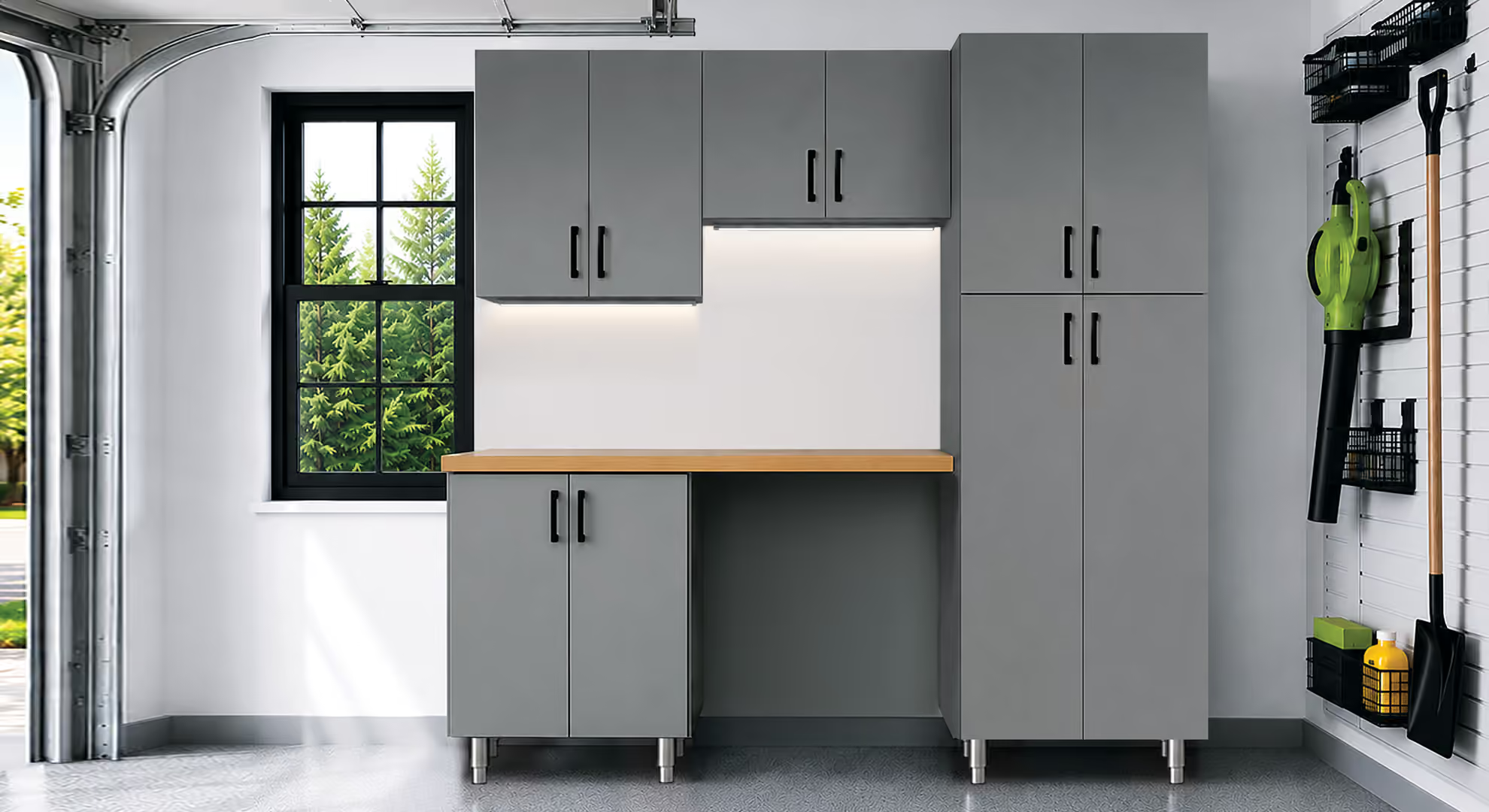
For ideas on a workbench wall, put the work surface between a tall cabinet and the drawer bases, and hang the wall cabinets above it. Check the weight sheet before you load them.
How do you install garage cabinets?
Install base cabinets first, level the first one at the highest point of the slab, clamp and screw the run together, then hang the wall cabinets. The Maverick guide lists eleven steps. It also warns that cabinetry can tip over and must be attached to the wall with devices suited to your wall.
The guide opens with a warning that serious or fatal crushing injuries can occur from cabinetry tip over. It says to use screws and plugs suitable for your walls and to seek professional advice if you are uncertain.
The steps in order:
- Verify the shipment against your order and inspect for visible damage. Report problems to your supplier right away.
- Prep the area. Mark each cabinet location on the walls and mark the wall studs.
- Install the leg assemblies as described above.
- Find the high spot of the floor. Mark a reference line 34 1/2 inches above it for standard base height, which is 36 inches with a countertop.
- Level the first cabinet at the highest point. It sets level and height for every cabinet after it.
- Secure base cabinets together. Align end panels flush, clamp them, drill pilot holes no deeper than 1 1/4 inch, and fasten with #8 x 1 1/4 inch stainless screws. Use a countersink bit.
- Install wall cabinets. Mark a reference line 54 inches above the finished floor, start in a corner and work outward. Secure them to studs, or use properly sourced fasteners for concrete or block. Follow local codes.
- Shim as needed so cabinets are level and flush against the wall.
- Adjust the doors after all cabinets are level and secured.
- Adjust the drawers with a #2 Phillips screwdriver.
- Install the handles. Handles are not pre-installed.
You need a drill, 3/16 inch and 1/8 inch wood bits, a concrete bit if you have a concrete wall, levels, a screwdriver and clamps. The guide recommends 2 foot and 4 foot levels. A helper makes lifting safer.
What should you ask a dealer before you order?
Ask for the facts that decide fit and safety. Bring a sketch of your garage wall, the ceiling height and a list of what you store. The questions below turn that into an order.
| Question | Why you ask it |
|---|---|
| Which cabinets match my wall width and the 84 in. tall height? | Tall cabinets must fit under your ceiling and any door track |
| What goes in each cabinet, and does it fit the weight limit? | Each cabinet has its own maximum load |
| What wall type do I have, and which fasteners suit it? | Wall cabinets must be anchored to studs or suitable fasteners |
| Is a work surface included? | The coordinating work surface is sold separately |
| Where will the handles go? | Pulls are included but not installed |
How do you care for garage cabinets?
Clean them with a microfiber cloth moistened with warm water or a soft sponge, plus a mild domestic cleaner with no abrasives. Then wipe with a soft cloth and fresh warm water, and dry the surface. Avoid scouring pads, bleach, strong acids and steam cleaners.
The care sheet cautions that storing open containers of caustic chemicals inside the cabinets can corrode the hinges, and it is not recommended. That is worth remembering in a garage where cleaners and solvents often live. Keep them closed or on a separate shelf.
What does the warranty cover?
The Maverick warranty covers repair or replacement of a defective article or part for five years from the date of purchase. It applies to residential use in the United States and is nontransferable. The sheet says the cabinetry is deemed accepted once assembly or installation is complete.
The sheet also says Innovation Cabinetry cannot accept requests for exchanges or returns for items that are assembled or installed. Check your delivery before you install. Register the warranty on the warranty page and keep your purchase order. Compare this with other lines: indoor lines carry a 10 year limited warranty, and the Endura outdoor line carries a limited lifetime warranty. Each line has its own terms.
Next step
See the full line on the Maverick Garageworx page, or read the garage cabinets overview. To buy, find a dealer and bring your garage measurements and a list of what you store.
Frequently asked questions
What are Maverick garage cabinets made of?
The Maverick brochure says each cabinet is built with 3/4 inch TFL furniture board, with a decorative surface permanently bonded to both sides. Invisa-Edge banding seals the edges. The site calls the cabinets frameless and lists stainless steel adjustable legs.
How much weight can a Maverick cabinet hold?
It depends on the cabinet. The weight tolerance sheet lists a maximum for each one, such as 225 lbs for a 3-drawer base and 60 lbs for a 15 by 30 inch wall cabinet. Those numbers assume the load is evenly spread. Drawer glides support up to 100 lbs.
Do garage cabinets arrive assembled?
Maverick cabinets are fully assembled, according to the Maverick brochure. That means no assembly before installation. You still need to level them, join them and anchor wall cabinets. Handles are included but not installed, so you place them where you want.
How long is the Maverick warranty?
The Maverick warranty is five years from the date of purchase, for residential use in the United States, and it is nontransferable. The warranty sheet also says that items cannot be exchanged or returned once assembled or installed. Read the full sheet before you buy.
Should garage cabinets sit on the floor or on legs?
Maverick uses heavy-duty stainless steel adjustable legs. The Maverick page says legs help level cabinets on uneven garage floors and raise storage off the ground for easier cleanup and added protection from moisture and debris.
How do I buy Maverick garage cabinets?
Through an authorized Innovation Cabinetry dealer. The company does not sell directly to homeowners. A dealer can help you pick from the 18 cabinets, plan zones and order a work surface, which is sold separately.
Terms on this page
Sources
- Innovation Cabinetry: Maverick garage cabinets page
- Innovation Cabinetry: Maverick Garageworx weight tolerance sheet (PDF)
- Innovation Cabinetry: Maverick step-by-step installation instructions (PDF)
Written by Innovation Cabinetry and checked against the sources above on October 29, 2026. Codes, standards and product details change, so check the linked page before you act.