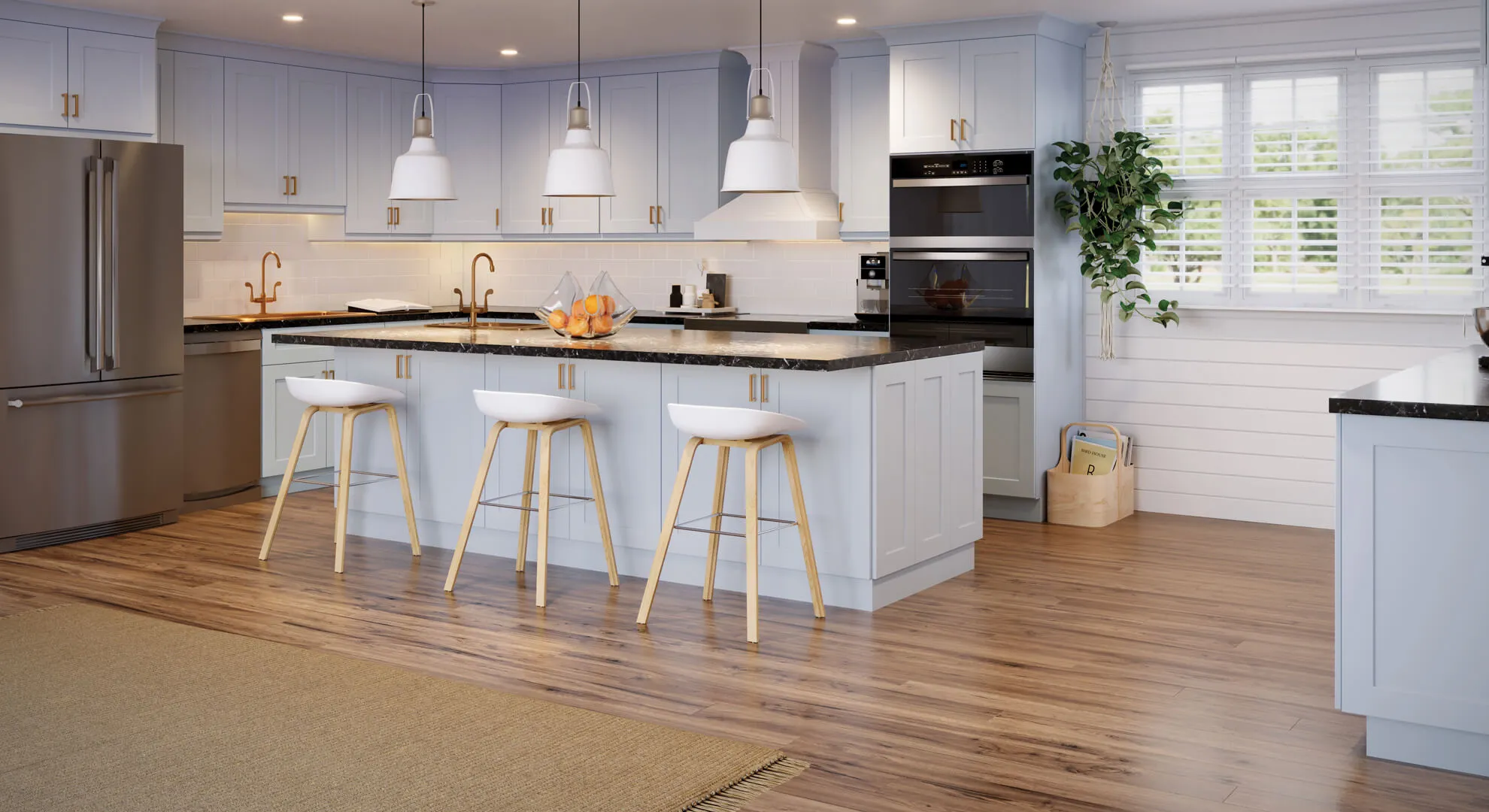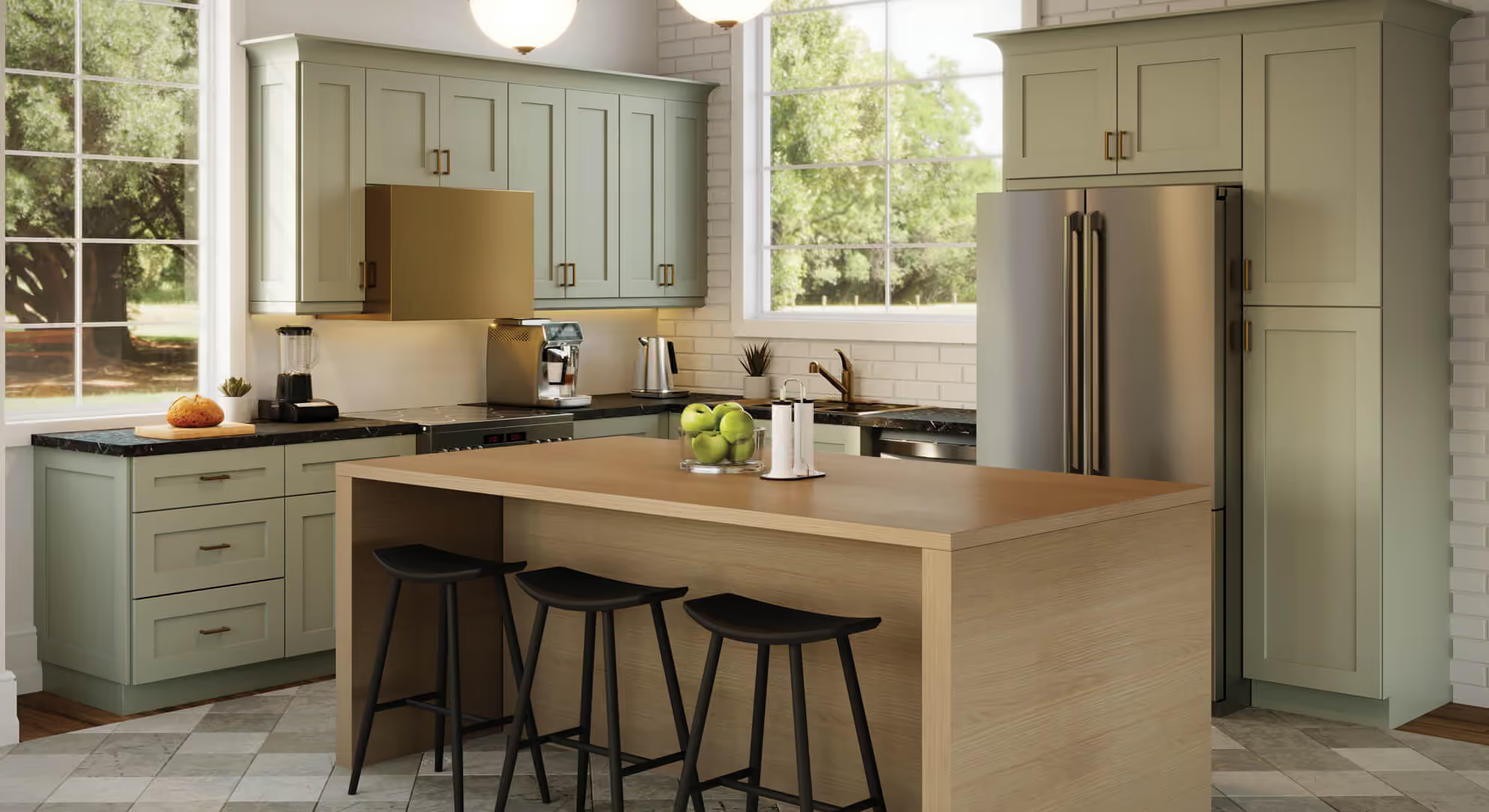
| Frameless | Face frame | |
|---|---|---|
| Front of the box | Open, no frame | Wood frame, about 1.5 in. wide |
| Door overlay | Full overlay | Full, partial or inset |
| Hinges mount to | Box side wall | Face frame |
| Interior access | Wider openings, taller drawers | Frame narrows the opening |
| Typical look | Modern, European | Traditional, furniture-like |
| Installation | Precise, tight reveals | More forgiving |
Sources: KCMA, Kitchen Cabinet Kings. Details are explained in the guide below.
What is the difference between frameless and face frame cabinets?
A face frame cabinet has a solid wood frame on the front of the box. Doors attach to that frame. A frameless cabinet has no frame. Doors attach to the box sides, and the doors cover the whole front. That one change drives most of the other differences.
KCMA (the Kitchen Cabinet Manufacturers Association) describes the face frame as typically 1.5 inches wide and three-fourths of an inch thick. It is made from hardwood that matches the cabinet. Face frame cabinets are often called American style. Frameless cabinets are often called European style or full-access cabinets.
Think of a face frame as a picture frame on the front of a box. It gives the front edge strength and a place to hang doors. It also covers part of the opening. Frameless cabinets give up the picture frame. They get the strength from thicker sides, floors and backs instead.
Both are normal, well-tested ways to build a cabinet. The question is which one fits your room, your layout and your installer.
Which one is stronger?
Neither is weaker by design. KCMA says people often assume framed cabinets are stronger because of the visible wood frame. Its answer is that a properly built frameless cabinet is equally durable, because both types can meet professional cabinet standards for long-term performance.
The strength just comes from different places. In a face frame cabinet, the frame keeps the box square and gives rigidity. KCMA also says the frame acts like a reinforced bridge, which helps with heavy countertops such as thick quartz or granite. In a frameless cabinet, the box itself does that job, so the sides and back need to be thick and well joined.
So the useful question is not “framed or frameless?” It is “how is this cabinet built, and was it tested?” Look at these points:
- Box material and thickness
- How the joints are made
- Whether the line is certified to ANSI/KCMA A161.1
- The hinge and drawer glide hardware
Kitchen Cabinet Kings, an online cabinet seller, makes the same point. It says there is no inherent difference in durability between the two types when both use high-quality materials and construction.
What does Innovation Cabinetry say about its own boxes?
The company’s EliteCraft brochure says its “3/4” plywood box panel construction is 50% thicker than industry standards.” The Urban brochure describes a “Sturdy 3/4” white plywood (11-ply) box construction.” These are the company’s statements. Ask your dealer for the spec sheet and a sample so you can judge for yourself.
Which one gives more storage and easier access?
Frameless gives more usable space, because no frame narrows the opening. Drawers can be taller and doors open onto the full width of the box. Sources put the gain at roughly 15% to 20%, and your layout decides the real number.
KCMA lists several access differences:
- Drawer height. In a face frame cabinet, the horizontal frame member reduces the interior height of a drawer. Frameless drawers can be taller.
- Center stiles. Face frame cabinets often include a vertical divider that can block access to wide shelves. KCMA says you can usually go up to 24 inches wide without one. Frameless cabinets can usually go wider without a center divider.
- Opening width. With no frame lip, you can slide wide items straight in.
On storage numbers, sources do not agree, and each number is a claim. KCMA says frameless cabinets generally give about 20% more storage and full access. Innovation Cabinetry says its full access frameless cabinets allow 15% more storage than framed cabinets, and its Diamond Difference page says base and wall cabinets give 15% more storage space “without the additional lip that framing requires.” Treat these as rough guides, not promises for your kitchen.
If you want to see how access changes in daily use, read about full access cabinets and the full overlay door style that goes with them. The companion guide on full overlay and full access cabinets goes deeper.
What about hinges and doors?
Frameless hinges mount to the inside of the box side wall. Face frame hinges mount to the frame. Kitchen Cabinet Kings puts it this way: frameless hinges mount directly onto the cabinet box itself, often with full overlay doors to hide them.
Hinge type changes how doors line up. Most modern frameless cabinets use concealed hinges that adjust in several directions. A soft-close hinge also slows the door in the last inch. Innovation Cabinetry says its EliteCraft and Urban doors use 6-way adjustable soft-close hinges. Adjustment matters because a frameless door has little room for error. The installer sets each gap by turning screws on the hinge. See hinge adjustment for how this works.
Door overlay is the second point. Face frame cabinets can use full overlay, partial overlay or inset doors. Frameless cabinets use full overlay. KCMA calls inset a specialized type of framed cabinetry and says it remains the most premium option, because the doors must sit precisely inside the opening.
Which door styles work with each type?
Door style and cabinet construction are separate choices. You can find a shaker door or a flat panel door on either type. Inset doors are the one style that belongs to face frame. Raised panel and slab doors work on both.
Innovation Cabinetry’s frameless lines cover several looks:
| Line | Construction | Door looks |
|---|---|---|
| EliteCraft Craftsman | Frameless, 3/4 in. plywood box | Shaker |
| EliteCraft Classic | Frameless, 3/4 in. plywood box | Raised panel |
| Urban | Full overlay, full access | Slab (Cityscapes) and shaker (Simplicity) |
| Maverick Garageworx | Frameless, full access, TFL | Garage cabinets |
Source: Innovation Cabinetry product pages and brochures.
Which is easier to install on uneven floors and walls?
Face frame is more forgiving. KCMA says the installer can use extended stiles or filler pieces to hide gaps where walls are not straight.
Frameless cabinets need more precision. KCMA says the tighter door and drawer reveals leave very little tolerance for uneven walls, floors or alignment. For a premium look, KCMA notes that applied panels can capture the full depth and hide gaps against uneven walls.
Practical steps for a frameless install:
- Find the highest point of the floor and start your layout there.
- Use adjustable legs or shims to level each base cabinet.
- Use a scribe strip where a cabinet meets an uneven wall.
- Adjust the hinges last, after the boxes are fixed and level.
- Plan the toe kick and end panels before the countertop goes on.
Both types need skilled installation. KCMA says so directly. A good installer matters more than the style you pick. Ask your dealer for an installer who has hung frameless cabinets before.
How do the two compare on cost?
Sources disagree, so do not decide on cost alone. KCMA says framed and frameless cabinets often have very similar linear foot pricing. Another seller, Kitchen Cabinet Kings, says framed cabinets are generally less expensive. Both can be true for different brands, because material, finish and line change price more than the frame does.
Innovation Cabinetry sells through authorized dealers and does not publish prices on its site. Your dealer will quote the final cost for your layout. When you compare quotes, compare the same door style, the same box material and the same hardware.
A few things change cost on any job:
- Inset doors, which need a face frame and tight tolerances
- Custom panels, fillers and end panels
- Soft-close glides and organizers
- Installation time on uneven rooms
Does certification matter more than style?
Yes. KCMA says that regardless of construction style, selecting quality certified cabinets is the most critical decision for a project’s longevity. KCMA A161.1 certification covers structural integrity, moisture resistance, hardware performance and finish durability.
One caution: certification applies to named lines, not whole companies. The KCMA certificate for Innovation Cabinetry lists named preassembled lines, such as Shaker White, Classic White and Bayport. It also says flat pack cabinets are not certified. So when you pick a line, ask your dealer whether that exact line and format is listed. The KCMA certification entry explains what the seal means.
What common myths should you ignore?
Three ideas come up often in cabinet shopping. Each one is only partly true.
- “A frame means a stronger cabinet.” KCMA calls this the strength myth. The frame helps with rigidity and heavy countertops, but a well-built frameless box is equally durable.
- “Frameless means cheaper or lower quality.” Style does not set quality. Materials, joinery and testing do. A thin box fails in either style.
- “Frameless only fits modern kitchens.” KCMA says frameless cabinets excel in modern, minimal or contemporary designs. Door style still changes the mood. A shaker or raised panel door on a frameless box reads as classic. The EliteCraft Classic line, for example, pairs a frameless box with raised panel doors.
Glass doors are a special case. Kitchen Cabinet Kings says framed cabinets are the better choice for glass doors because they keep the hinges hidden. Frameless glass doors are possible. Innovation Cabinetry’s Classic White page offers a glass front option, and says glass and clips are not included. Ask your dealer to show you how the hinges look through the glass before you commit.
Which type suits small kitchens, baths and garages?
Small rooms often gain the most from frameless boxes, because every inch of opening counts. A wider drawer and a taller pull-out make a narrow room easier to use. Accessories such as a lazy susan or blind corner organizer also work best when the opening is clear.
Garages follow the same logic. Garage cabinets hold bulky tools and bins. An open front lets you slide wide items in and out. Maverick Garageworx is frameless and full access for that reason, with stainless steel adjustable legs to level cabinets on uneven garage floors.
Face frame can still be right for a small room. If the room has crooked walls, or you want a traditional inset look, a frame hides the flaws and sets the style.
How do you choose? A decision table
Use the table below as a starting point. If most answers land in one column, that column is probably your match.
| Question | Leans frameless | Leans face frame |
|---|---|---|
| What look do you want? | Clean, modern, European | Traditional, furniture-like, inset |
| How much do you need to store in drawers and pull-outs? | A lot, and wide items | Standard needs |
| How level are your walls and floors? | Fairly level, or you can fix them | Noticeably uneven |
| Do you want inset doors? | No | Yes |
| How heavy is the countertop? | Any, with a quality box | Very heavy stone, extra frame support helps |
| What is your installer’s experience? | Has hung frameless before | Prefers a forgiving system |
Two honest notes. First, frameless is not “better.” It is a different trade. Second, the best cabinet is the one built to a tested standard and installed well, whichever type it is.
What does Innovation Cabinetry offer?
Innovation Cabinetry, a Tampa, Florida company, sells frameless cabinets through authorized dealers. EliteCraft comes in Craftsman shaker and Classic raised panel doors. Urban is a European-style full-access line. Maverick Garageworx brings the same frameless approach to the garage. The company does not sell face frame cabinets on these lines.
If you want a face frame look, such as inset doors, this company is not the match. If you want the frameless trade-offs described above, the lines fit well. The frameless cabinets page lists the construction details in one place.
Next step
See the Urban full-access collection and the frameless cabinets page for construction details. Then find a dealer to see samples, check which lines are KCMA listed, and get a quote for your layout.
Frequently asked questions
Are frameless cabinets as strong as face frame cabinets?
Yes, when they are built well. KCMA says a properly built frameless cabinet is equally durable, because both types can meet professional cabinet standards. The box sides, back and floor carry the load instead of a frame, so material thickness and joinery matter most.
Do frameless cabinets have more storage?
Usually, yes. Without a frame, openings are wider and drawers can be taller. Sources quote different gains. KCMA says about 20%. Innovation Cabinetry says its full access frameless cabinets give 15% more storage than framed cabinets. Your layout decides the real number.
What hinges do frameless cabinets use?
Frameless hinges mount to the inside of the box side wall, not to a frame. Most are concealed and adjustable. Innovation Cabinetry's EliteCraft and Urban lines use 6-way adjustable soft-close hinges, which let an installer fine-tune each door.
Are frameless cabinets harder to install?
They need more precision. KCMA says frameless cabinets require more precise installation because no frame hides inconsistencies. Uneven floors and walls show in the door gaps. Plan for shims, a level starting point and a careful installer.
Can frameless cabinets have inset doors?
Not in the usual sense. Inset doors sit inside a frame opening, so they need a face frame. KCMA calls inset a specialized form of framed cabinetry. Frameless cabinets use full overlay doors that cover the whole box front.
Which type costs less?
Sources disagree, so no rule holds. KCMA says the two often have very similar linear foot pricing. One seller says framed usually costs less. Compare quotes for your layout from a dealer. Innovation Cabinetry publishes no prices, and dealers set them.
Does the style affect KCMA certification?
No. KCMA A161.1 certification applies to both styles. It tests structural integrity, moisture resistance, hardware performance and finish durability. Check that the specific line you choose is listed, because a brand can have certified and non-certified lines.
Terms on this page
Sources
- KCMA: The Differences Between Framed and Frameless Cabinets
- Kitchen Cabinet Kings: Framed vs. Frameless Cabinets
Written by Innovation Cabinetry and checked against the sources above on October 29, 2026. Codes, standards and product details change, so check the linked page before you act.