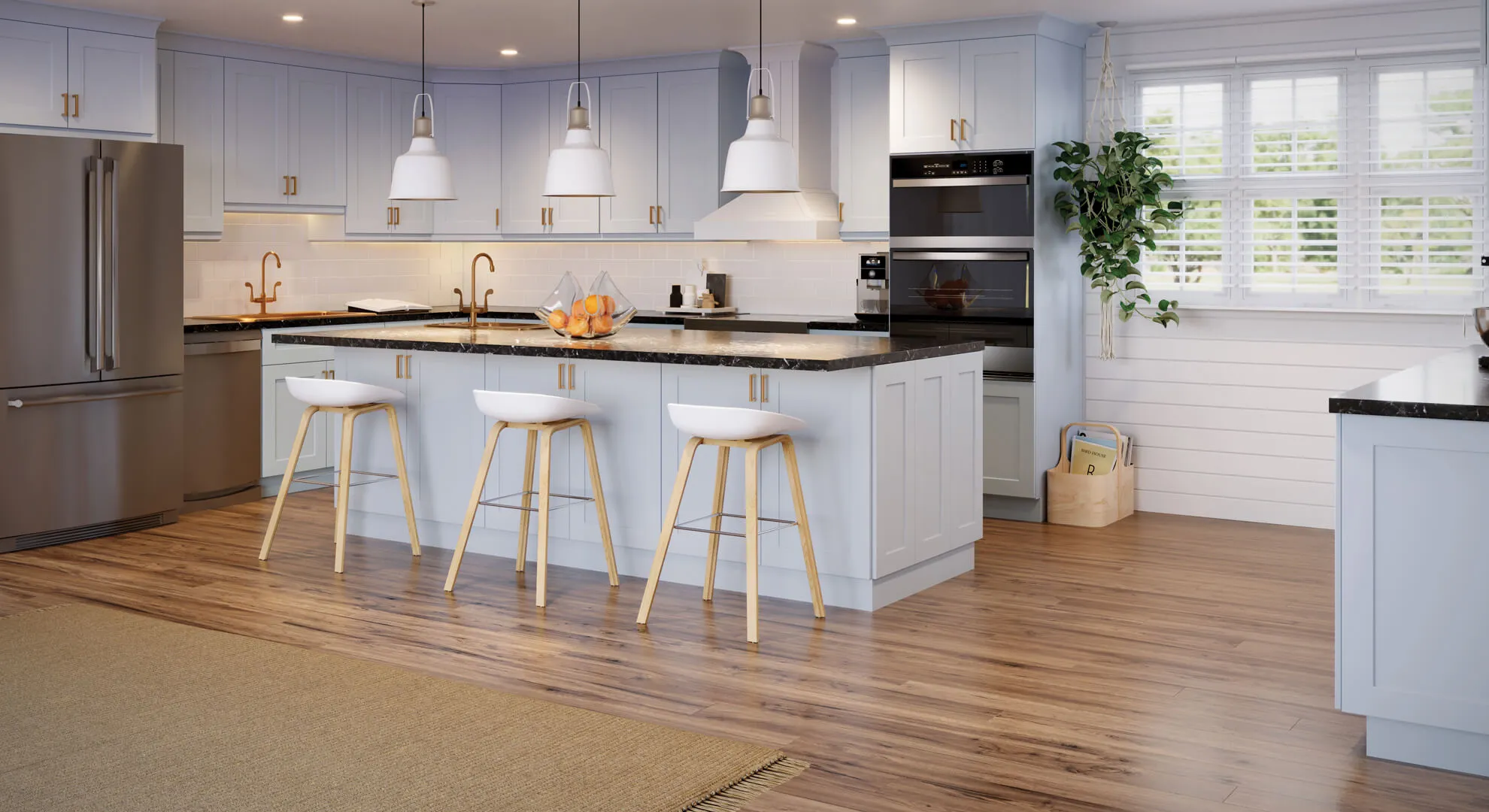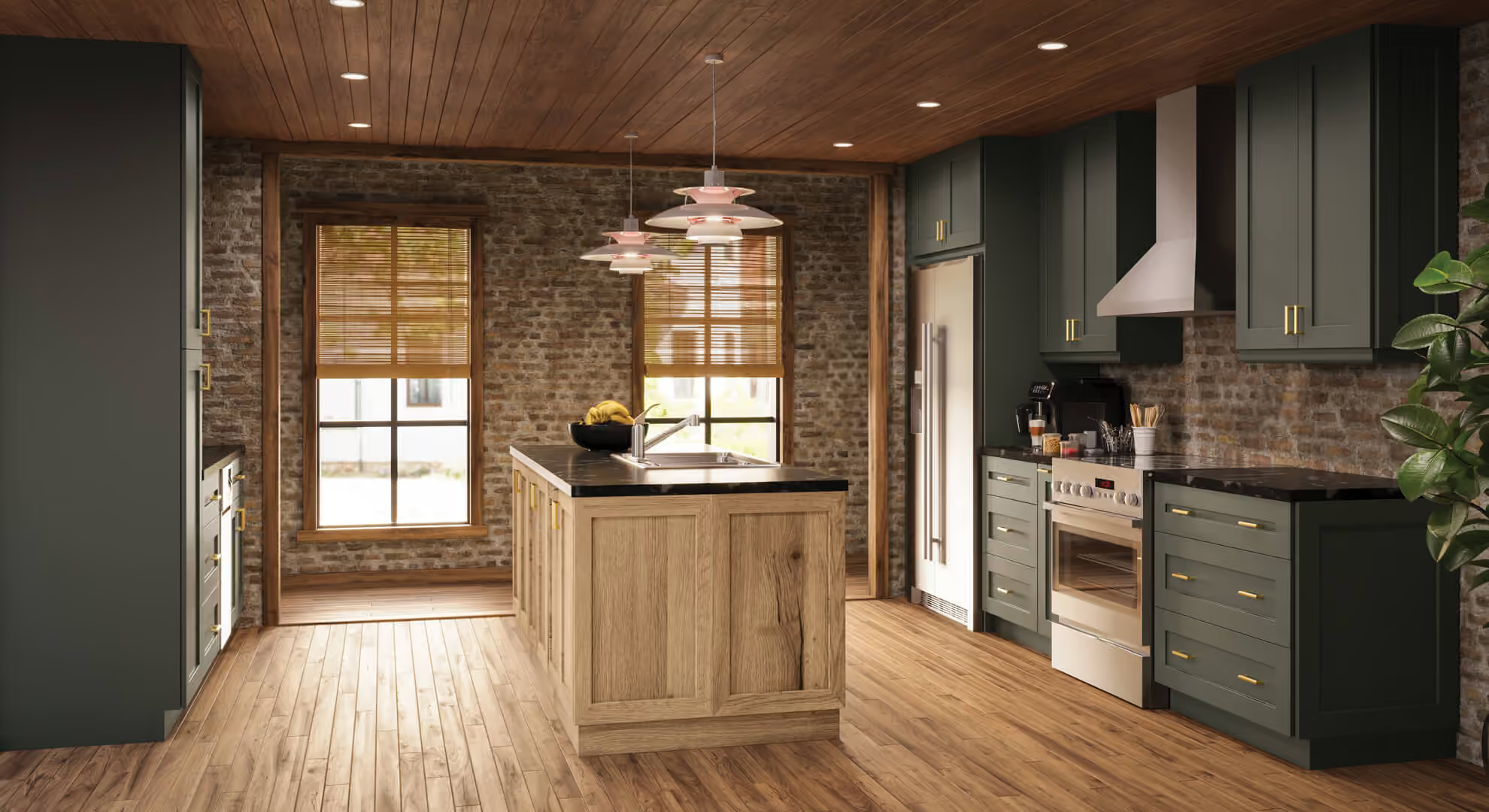
| Frameless | Face frame | |
|---|---|---|
| Front of the box | Open, no frame | Solid wood frame, about 1.5 in. wide |
| Door overlay | Full overlay | Partial overlay, full overlay or inset |
| Source of strength | Thicker box sides, floor and back | The face frame plus the box |
| Opening size | Wider, with no center stile on most widths | Narrowed by the frame and any center stile |
| Typical look | Modern, minimal, contemporary | Traditional or transitional |
| Installation | Less forgiving on uneven walls | More forgiving, frame can hide gaps |
| Pricing per linear foot | Often very similar | Often very similar |
Comparison points follow KCMA, The Differences Between Framed and Frameless Cabinets (kcma.org). Overlay and stile details are general to each construction type.
What is a frameless cabinet?
A frameless cabinet has no face frame on the front of the box. The doors cover the whole box, and the opening is wider. Many people call this style European or full access. KCMA, the Kitchen Cabinet Manufacturers Association, says frameless cabinets “eliminate the face frame entirely.”
A face frame is a solid wood border, about 1.5 inches wide, attached to the front of a traditional cabinet. In a frameless cabinet, that border is gone. The box panels carry the load. You see clean fronts and tight, even gaps between doors.
KCMA says frameless cabinets are growing in popularity in the United States, after an established lead in the Canadian market.
How are frameless and face frame cabinets different?
The main difference is the frame. A face-frame cabinet has a wood border on the front. A frameless cabinet does not. That one change affects how doors mount, how wide the openings are, which looks you can get, and how forgiving the install is.
The table at the top of this page lists the points side by side. Here are the ones that matter most:
- Doors: Face frame can use partial overlay, full overlay or inset doors. Frameless cabinets use a full overlay look.
- Strength: Face frame cabinets get rigidity from the frame. Frameless cabinets get it from thicker box panels.
- Openings: A face frame narrows the opening. KCMA notes that framed cabinets often add a center stile, a vertical divider that can block access to wide shelves.
- Style: Face frame suits traditional rooms with raised panels and crown molding. Frameless suits modern, minimal and transitional rooms.
For a longer comparison, read the frameless vs face frame guide.
Do frameless cabinets give you more storage?
Yes, in most layouts, because the frame no longer narrows the opening. Innovation Cabinetry states that its frameless interiors give 15% more storage than standard framed cabinets. KCMA’s guide puts the general gain at about 20%. Your real gain depends on the cabinet size.
The company explains the gain this way: drawer space is higher and deeper, and base and wall cabinets have no lip from a frame. In a face frame cabinet, the horizontal frame piece cuts the height of a drawer. Large items then fit less easily.
Treat these percentages as manufacturer and trade claims, not guarantees. They compare two box types of the same outside size. A lazy Susan, a blind corner or an organizer can change your real storage more than the frame does. See the storage accessories guide for options.
What does full overlay mean?
Full overlay means the door or drawer front covers nearly the whole front of the cabinet box. Only thin gaps show between fronts. Frameless cabinets use this look. The full overlay style is why frameless kitchens look clean and flat.
Partial overlay doors leave a visible strip of the frame showing. Inset doors sit inside the frame opening, flush with it. Both of those need a face frame. A frameless box has no frame for a door to sit in, so full overlay is the natural fit.
The Urban color pages say it plainly: “Full overlay frameless cabinets allow for wider drawer and door openings.” Read the full overlay and full access guide for hinge and gap details.
What does “full access” mean?
Full access means nothing blocks the opening. You reach the whole interior of the box when the door or drawer is open. There is no frame lip and no center stile in the way. Innovation Cabinetry uses the phrase in the Urban collection name.
KCMA uses the same words for frameless boxes: “full-access cabinets” that “derive their strength from the cabinet box itself.” The full-access idea is the practical result of removing the frame.
KCMA also notes that frameless cabinets can usually hold wide drawers and roll-out pantries, up to 36 inches, with no center partition. Face frame cabinets can usually go to about 24 inches wide before a center stile is needed. These are general trade figures, not specs for one product line.
Are frameless cabinets more expensive?
Not by type alone. KCMA says framed and frameless cabinets often have very similar linear foot pricing. The cost of your kitchen depends on the line, door style, finish, size and options. Only a dealer quote can tell you what a given layout costs.
Innovation Cabinetry does not publish prices. Dealers set their own quotes. Ask each dealer for the same layout in the same line so you can compare like with like.
Two cost items are worth asking about. The first is installation. Frameless installs need more precision, so labor can differ. The second is trim. Panels and fillers can hide gaps against uneven walls, and those add parts to the order.
Are frameless cabinets harder to install?
They are less forgiving. KCMA says frameless cabinets require more precise installation because there is no face frame to conceal inconsistencies. Door and drawer gaps are tight, so uneven walls, floors or alignment show right away.
A face frame can be trimmed or covered to hide a wall that is not straight. A frameless box cannot. A good installer checks the room first, shims the boxes level and uses a scribe or a filler at the wall where needed.
Hinges help too. The Urban and EliteCraft pages list 6-way adjustable, soft-close hinges. The door can be tuned in several directions after the box is set. That makes final alignment easier. See hinge adjustment for the basic steps.
Weight is a second install point. KCMA notes that a face frame acts as a bridge under heavy countertops, such as thick quartz or granite. With frameless cabinets, ask your installer how the boxes will carry the stone.
Do frameless cabinets last as long as face frame?
Yes, when they are built well. KCMA says a properly built frameless cabinet is equally durable, as both types can meet professional standards. KCMA also says certified construction is the most important choice, whatever the style.
KCMA says its A161.1 certification tests structural integrity, moisture resistance, hardware performance and finish durability. The Innovation Cabinetry brochures and pages name KCMA and CARB2 for some lines. Certification covers named lines only, so ask your dealer which certificate applies to the exact line you pick. See KCMA certification for the basics.
Box material counts too. The Urban and EliteCraft pages list a 3/4 inch plywood box. That is 50% thicker than the industry standard. Maverick Garageworx uses 3/4 inch TFL furniture board.
Warranty terms differ by line. Indoor cabinetry carries a 10-year limited warranty. Maverick carries a 5-year limited warranty. Read the full terms on the warranty page.
What should you ask before you choose frameless?
A few plain questions save trouble later:
- How level and straight are my walls and floor?
- Will the layout need fillers or panels at the walls?
- What box material does this line use, and how thick is it?
- Which quality certification covers this exact line?
- Who installs the cabinets, and who handles a warranty claim?
Write the answers down. Compare them between dealers, not only the quotes.
Which Innovation Cabinetry collections are frameless?
Three lines are described as frameless on our pages: Urban, EliteCraft and Maverick Garageworx. Each is sold through authorized dealers, not direct to homeowners.
- Urban: European-style, full-access, full overlay. Slab and shaker fronts in many colors.
- EliteCraft: The Craftsman line is shaker style. The Classic line has raised panel doors. Both are described as frameless.
- Maverick Garageworx: Garage cabinets. The page says they “feature frameless construction for a clean, modern appearance and more usable storage space inside every cabinet.”
The company does not call its Endura outdoor line frameless on its pages. It lists a “full-access box construction” for Endura. Read the Endura page for what the line offers.
Door shapes and colors are covered in the door styles and colors pillar.
How do I buy frameless cabinets?
You buy through an authorized dealer. Innovation Cabinetry says it is a wholesaler and does not sell directly to the public. Use the find a dealer form. The company matches you with a professional in your area, such as a contractor, builder or design professional.
The usual path looks like this:
- Pick a line and color you like. Ask for a door sample.
- Submit the find a dealer form.
- Have the dealer measure your room and draw the layout.
- Review the quote, the delivery plan and the warranty terms.
- Order, receive the cabinets and have them installed.
The full walk-through is in how to buy cabinets. After install, register your warranty on the warranty page.
Next step
See the Urban collection for modern full-access cabinets, or browse EliteCraft for shaker and raised panel doors. When you are ready, find a dealer near you.
Frequently asked questions
Are frameless cabinets better than face frame cabinets?
Neither is better for everyone. Frameless gives a wider opening and a modern look. Face frame suits traditional rooms and inset doors. KCMA says a properly built frameless cabinet is equally durable. Pick the look and access you want, then check the maker's quality certification.
Do frameless cabinets hold less weight?
Not when they are built well. KCMA says both types can meet professional cabinet standards for long-term performance. Frameless boxes rely on thicker panels instead of a frame. Ask your dealer about the box material and the countertop you plan to use.
What hinges do frameless cabinets use?
Frameless doors use hinges that mount to the box side, since there is no frame. The Urban and EliteCraft pages list 6-way adjustable hinges with a soft-close mechanism. Six-way means you can fine-tune the door position after install.
How much more storage do frameless cabinets give?
Innovation Cabinetry states that its frameless interiors give 15% more storage than standard framed cabinets. KCMA's guide says frameless cabinets generally give about 20% more. Exact gains depend on the cabinet size and layout.
Are frameless cabinets harder to install?
They need more care. KCMA says frameless cabinets require more precise installation because no frame conceals inconsistencies. A licensed installer or a dealer's install partner should check walls and floors before the boxes go up.
Can I buy Innovation Cabinetry frameless cabinets directly?
No. Innovation Cabinetry says it is a wholesaler and does not sell directly to the public. Use the find a dealer form and the company matches you with a professional in your area.
Terms on this page
Sources
- KCMA: The Differences Between Framed and Frameless Cabinets
- Innovation Cabinetry: Urban Emerald
- Innovation Cabinetry: Diamond Difference
- Innovation Cabinetry: dealer login notice
Written by Innovation Cabinetry and checked against the sources above on October 29, 2026. Codes, standards and product details change, so check the linked page before you act.