How humid is Tampa Bay?
Tampa Bay is humid for much of the year, and very humid in summer. The National Weather Service says the rainy season brings “persistent dew point values above 70°F.” For most of West Central Florida, that season runs from May 25 to October 10.
Dew point is the best number to watch. The National Weather Service explains that “the higher the dew point, the greater the amount of moisture in the air.” Relative humidity can mislead, because warm air holds more water.
Tampa’s dew point record is 86°F, set on August 6, 2000. The longest run of days with dew points of 75°F or higher is seven, from August 5 to 11, 2024. In a stretch like that, a house with weak air conditioning keeps moisture inside.
What does humidity do to kitchen and bath cabinets?
Moisture gets into cabinets through edges, seams, cut-outs and spills. It rarely harms a sealed surface on a dry day. The trouble starts when water sits, whether from a leak, a drip or damp air that never leaves the room.
| Spot | Common moisture source | What to do |
|---|---|---|
| Under the kitchen sink | Supply line or drain drips | Check for wet spots each month |
| Next to the dishwasher | Steam when the door opens | Run the exhaust fan or open the window to a dry space |
| Above the range | Cooking steam and grease | Vent the hood outside |
| Bath vanity area | Shower steam | Run the bath fan during and after showers |
| Toe-kick area | Mop water and floor moisture | Wipe dry after cleaning |
| Closed rooms | Humid air with no air conditioning | Keep the air moving and use a dehumidifier if needed |
The EPA says condensation on windows, walls or pipes “can be a sign of high humidity.” If you see it, act quickly to dry the surface and cut the moisture source.
How do you keep indoor humidity in a safe range?
Keep indoor humidity below 60 percent, and ideally between 30 and 50 percent. That is the EPA’s advice, and it applies to cabinets as much as to walls and floors. A hardware store humidity meter costs little and tells you where you stand.
Use these steps in a Tampa Bay home:
- Keep the air conditioner running in summer, even when you travel.
- Vent the range hood and bath fans to the outside, not into the attic.
- Wipe water off countertops, sink rims and cabinet doors the same day.
- Fix leaks as soon as you find them.
- Use a dehumidifier in closed rooms that run damp.
The EPA also says to vent moisture-producing appliances, such as clothes dryers and stoves, to the outside where possible.
Which cabinet materials and finishes suit a humid climate?
Pick sealed surfaces, sealed edges and sturdy boxes. Then look at the details: how the edges are finished, what the interior surface is and how the maker describes the moisture behavior. Ask for those details in writing from the dealer.
Here is what Innovation Cabinetry states for its lines:
- Urban: the box is 3/4 in. white plywood (11-ply) with a white TFL interior and exterior finish. The brochure says “Resin based TFL is permanently heat bonded to the substrate; it will not peel or fade and has superior impact resistance.” Urban Cityscapes slab doors use Invisa-edge banding.
- Maverick Garageworx: TFL surfaces and Invisa-Edge edge banding that the brochure calls a “moisture-resistant finish.”
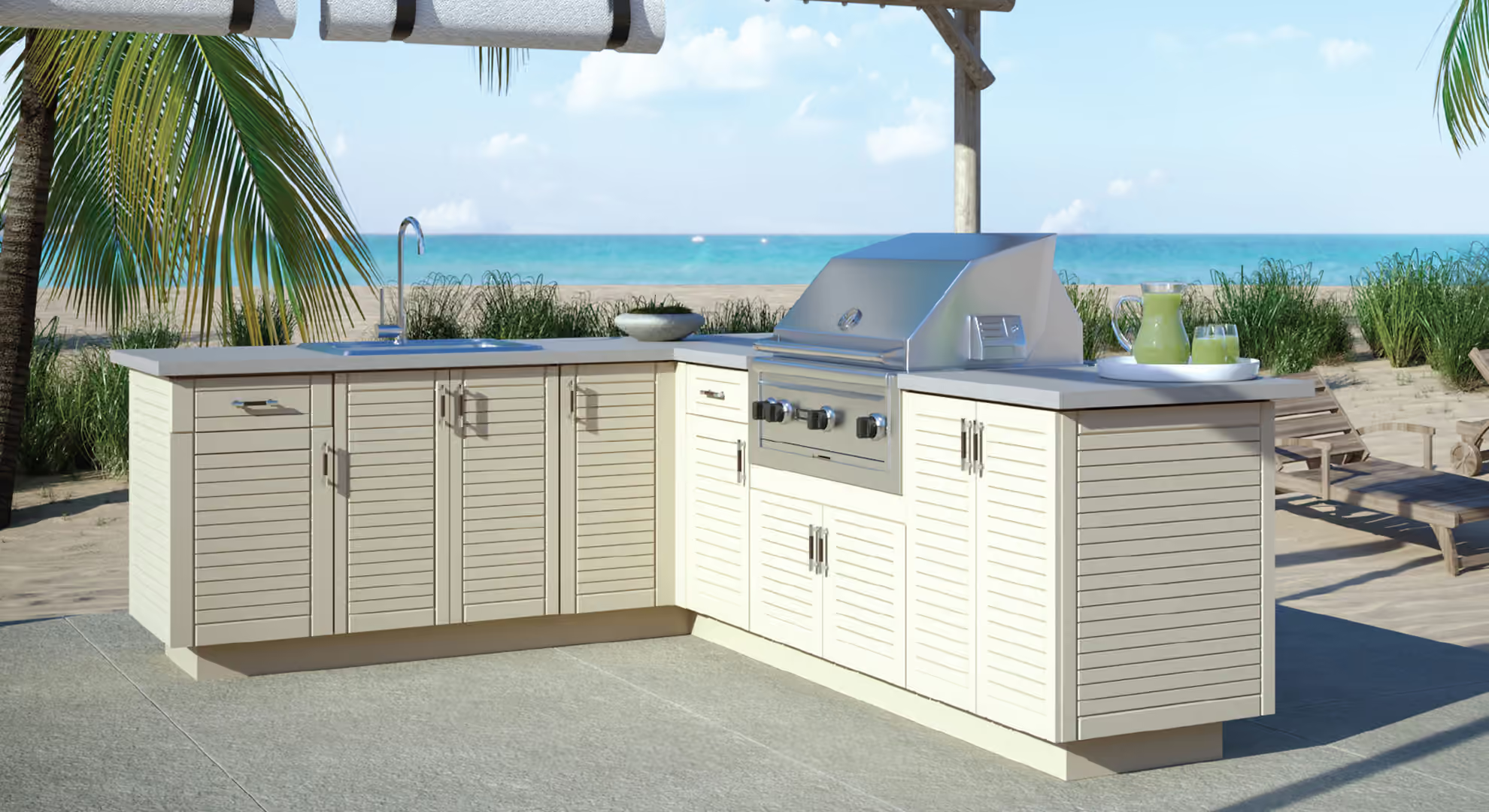
- Endura: 3/4 in. marine-grade HDPE for outdoor kitchens, covered in the outdoor kitchen cabinets overview.
A plywood box and a sealed TFL surface are not waterproof. Both resist moisture better when the edge banding stays tight and clean. Plywood and TFL cabinets are made for indoor rooms, not for wet outdoor use.
How should you clean and care for cabinets in humid weather?
Use a soft cotton cloth dampened with warm water for most cleaning. Innovation Cabinetry’s care sheet says that is usually enough. Dry the surface afterward, and avoid waxing.
The care sheet also allows mild dish liquid in warm water or a mild all-purpose cleaner “that does not contain ammonia or silicone.” It warns that stronger products may damage or discolor the finish and may void the warranty. Spray glass-door cleaner on the cloth, not on the glass.
Dry the cabinets near the sink, dishwasher and range most often. Look at the bottom edges, since they sit closest to the floor. If a door starts to hang unevenly, check the hinge adjustment before you assume the door is warped.
What else do Florida homeowners ask?
Most questions come down to the room and the plan. The Florida cabinet guide covers climate, storms and buying in more detail. For a room with a lot of steam, such as a laundry or a bath, vent it well and pick finishes you can wipe clean.
If your home faces repeated moisture problems, find the water source first. New cabinets will not fix a leak or a failed air conditioner. A licensed contractor can check the cause.
Register the warranty after you buy. Indoor lines carry a 10-year limited warranty, so register your warranty and keep your receipt.
Next step
Explore the Florida cabinet guide to compare lines for your home. Then find a dealer in Tampa Bay to see samples and ask how each finish handles moisture.
Frequently asked questions
How humid is Tampa Bay?
The National Weather Service Tampa Bay says the rainy season, May 25 to October 10 for most of West Central Florida, brings persistent dew points above 70°F. Tampa's highest recorded dew point is 86°F. Dew point shows how muggy the air feels better than relative humidity does.
What humidity level should I keep indoors?
The EPA advises keeping indoor humidity below 60 percent, ideally between 30 and 50 percent relative humidity. A small humidity meter from a hardware store tells you where your home stands. Use your air conditioner and bath fans to stay in range.
Can humidity damage kitchen cabinets?
Standing moisture is the main risk, especially at edges, seams and under sinks. Wipe spills and drips quickly, fix leaks and control indoor humidity. Choose cabinets with sealed edges and moisture-resistant surfaces, and follow the care sheet for your line.
Are Innovation Cabinetry cabinets good for Florida?
Innovation Cabinetry is based in Tampa. Its Urban line uses a plywood box with TFL surfaces, and the brochure describes edge banding that seals seams. No cabinet is humidity-proof. Ask a dealer how your line suits your room, and read the warranty for terms.
Should I use a dehumidifier?
A dehumidifier helps in rooms where air conditioning does not keep humidity in range, such as a closed garage or a spare bath. Use a meter to check the level first. Do not run a dehumidifier to fix a leak, since you need to find and stop the water.
Terms on this page
Sources
- National Weather Service Tampa Bay: Dew Point Statistics
- National Weather Service Tampa Bay: Florida Thunderstorm Season
- US EPA: A Brief Guide to Mold, Moisture and Your Home
Written by Innovation Cabinetry and checked against the sources above on October 9, 2026. Codes, standards and product details change, so check the linked page before you act.