Why does salt air damage outdoor cabinets?
Salt spray and fog carry salt onto every exposed surface, and salt speeds up rust on steel. NASA names the corrosive effect of saltwater-laden ocean spray and fog as one of the most destructive forces at its Florida launch site. A patio near the Gulf shares that basic problem on a smaller scale.
NASA also tracks how corrosion changes with distance from the ocean. Its test data covers how corrosion changes with that distance. A kitchen at the water’s edge generally sees more salt than one far inland, but both deal with warm, humid air.
Humidity matters too. The National Weather Service Tampa Bay describes the rainy season as “warm, humid conditions with frequent showers and thunderstorms.” Moisture plus salt gives corrosion what it needs. Damp salt that never dries is the worst case.
Which parts of an outdoor cabinet corrode first?
The metal parts corrode first: hinges, legs, screws, pulls and drawer glides. The body is rarely the first failure when it is made of a material that does not rust. Check each metal part when you compare cabinets.
| Part | Why it is at risk | What to look for |
|---|---|---|
| Hinges | Moving metal that traps wet salt | Stainless steel, soft-close, adjustable |
| Legs and feet | Sit low where water and salt collect | Stainless steel, adjustable height |
| Screws and fasteners | Small gaps hold moisture | Hidden joinery with no exposed fasteners |
| Drawer glides | Hidden tracks stay damp | A glide system built for outdoor use |
| Pulls and handles | Touched often, exposed to spray | Corrosion-resistant finish |
| Cabinet body | Large flat panels face the weather | A material that does not rot or rust |
Bare steel and painted steel give salt a place to start. A scratch in paint exposes the metal under it.
How is an Endura cabinet built for coastal air?
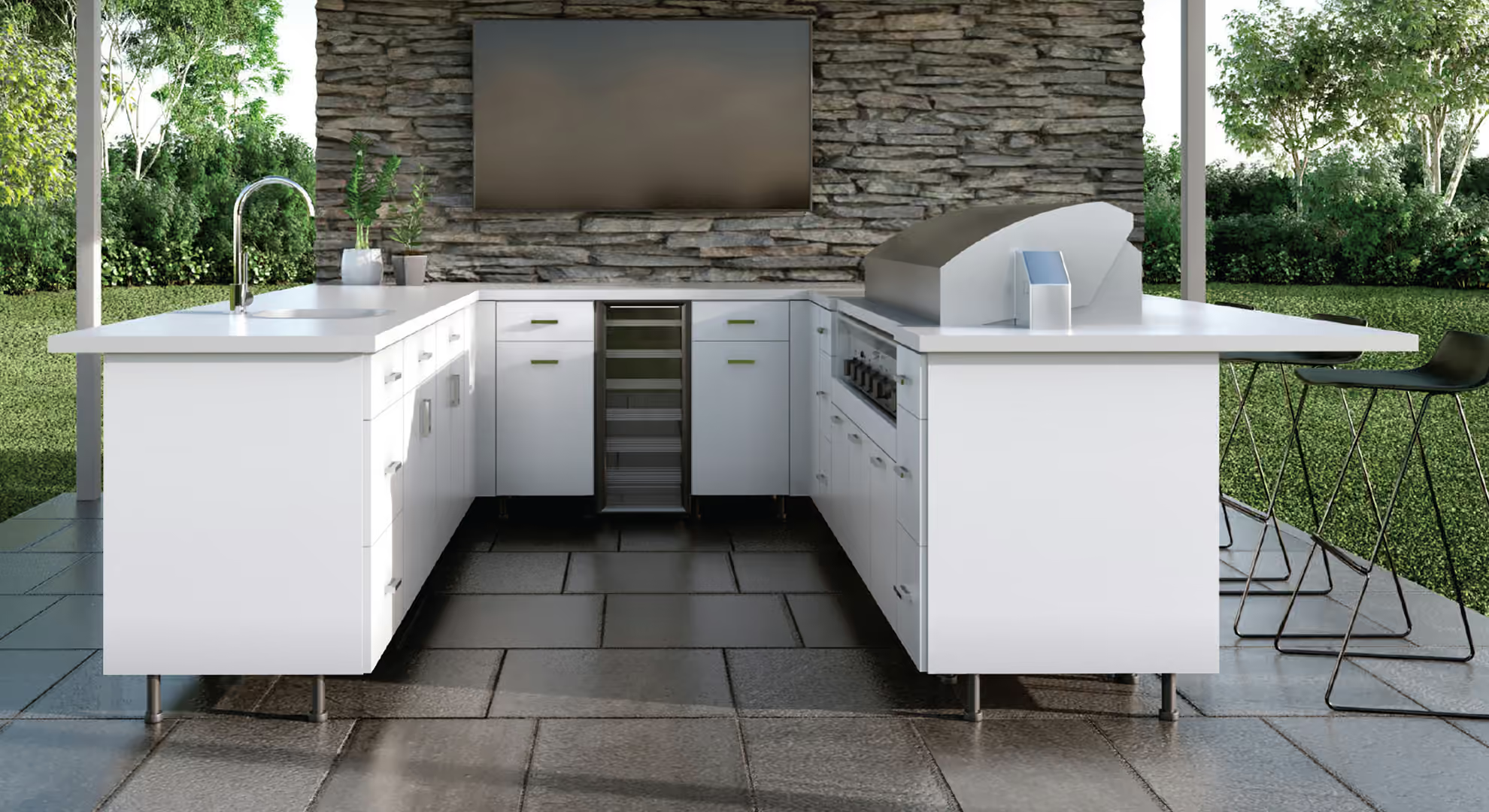
Endura cabinets use a HDPE body, 304 stainless steel hinges and 304 stainless steel legs. The Endura brochure describes the body as 3/4 in. marine-grade, all-weather high-density polyethylene. It says the cabinets never need sanding or painting.
Here is what the Innovation Cabinetry Endura materials say, in short:
- Body: “The 3/4” marine-grade HDPE is UV and weather-resistant. Cabinets will never rot, delaminate, or splinter and never need refinishing.”
- Hinges: 304 stainless steel, 6-way adjustable, with a soft-close hinge mechanism.
- Legs: “Adjustable rust-resistant 304 stainless steel legs,” with a 3-5/8 in. by 4 in. mounting plate.
- Joinery: a hidden system with no visible fasteners or screws.
- Drawer glides: a Poly-Glide system, with an optional stainless steel soft-close glide for an additional charge.
The Endura material datasheet adds that the material is FDA and USDA approved and meets ASTM D4976. A marine-grade polymer body does not carry the rust risk of a steel body, which is why the other metal parts deserve your attention.
Innovation Cabinetry does not publish a salt-spray test rating for Endura. Do not read the word “marine-grade” as a guarantee against all corrosion. Ask your dealer how the cabinets fit your site.
How do you protect cabinets near saltwater?
Rinse them, dry them and look at the hardware. A routine takes about ten minutes. Salt does its worst damage when it sits for weeks.
- Rinse the cabinet fronts, hinges and legs with fresh water every month near the coast.
- Wipe metal parts dry, especially the hinge area and the leg plates.
- Clean with hand washing liquid soap or another cleaner on the Endura care sheet.
- Avoid abrasive cleaners such as scouring powders, which scratch the surface.
- Keep a pressure washer at 1,500 PSI or less, per the care sheet.
- Check screws on your appliances and trim, since those often come from other makers.
Look at what surrounds the cabinets. A grill, a sink faucet and a trim piece may use steel that rusts and drips onto the cabinet. Fix the source of any rust stain, since cleaning alone will not stop it.
Does salt air change how you plan the layout?
Yes. Keep cabinets a little off the ground, let air move around them and give water a path to drain. Adjustable legs lift the body above the slab, and a toe-kick panel can close the gap for a finished look.
Endura offers a clip-on toe-kick as an option. The product pages list total overall height that adjusts from 34 in. to 35.875 in. Use that range to level cabinets on a slab that slopes for drainage.
Think about sun, too. A shaded corner can stay damp longer than a sunny one, so rinse it more often. The guide to outdoor kitchen cabinet materials compares options in more detail.
What should you ask a dealer?
Ask what the cabinet body is made of, what grade of stainless steel the hinges and legs use, and how the warranty treats outdoor conditions. Endura carries a limited lifetime warranty, with 5 years on hinges, legs and factory hardware. Read the full text before you buy.
Bring your site details: distance from the water, shade, and which appliances you plan to use. Your dealer can match a door style and color to the plan. See the outdoor kitchen cabinets overview for all five Endura door styles.
Next step
Browse the Endura outdoor kitchen cabinets and note which hinge and leg details matter for your patio. Then find a dealer who can walk through your site and your salt exposure with you.
Frequently asked questions
Does salt air damage outdoor kitchen cabinets?
Salt air attacks metal first. NASA describes saltwater-laden ocean spray and fog as one of the most destructive forces at its Florida launch site. Cabinet bodies made of a material that does not rust, plus corrosion-resistant hardware, handle the exposure better than bare steel.
Are Endura cabinets safe for coastal homes?
Endura bodies are 3/4 in. marine-grade HDPE, and the hinges and legs are 304 stainless steel that the brochure calls rust-resistant. Innovation Cabinetry makes no salt-spray rating claim. Ask your dealer about your exact site, especially if the kitchen sits at the water's edge.
Is stainless steel rust-proof?
No metal is rust-proof in every setting. Stainless steel resists rust well, but salt, moisture and trapped dirt can still stain or pit it. Rinse the hardware with fresh water and wipe it dry. Check it each season.
How do I clean salt off outdoor cabinets?
Use the cleaners Innovation Cabinetry lists in its Endura care sheet, such as hand washing liquid soap, glass cleaner or a diluted bleach mix. Avoid abrasive cleaners. Keep a pressure washer at 1,500 PSI or less.
Does the warranty cover corrosion?
Read the Endura warranty for the exact terms. It covers defects in material and workmanship under its stated conditions, with a 5-year limited warranty on hinges and leveling legs. Ask your dealer how it treats normal wear and outside conditions.
Terms on this page
Sources
- NASA Technical Reports Server: Corrosion Control at Space Launch Pads
- National Weather Service Tampa Bay: Florida Thunderstorm Season
Written by Innovation Cabinetry and checked against the sources above on October 6, 2026. Codes, standards and product details change, so check the linked page before you act.